
At LSRmold, a precision manufacturer and factory providing full one-stop service, we help product teams, design engineers, and procurement partners (OEMs and suppliers) correctly specify fatigue testing and materials so that parts meet service-life expectations. Fatigue testing is where design intent meets real-world durability — getting it right reduces warranty costs, speeds certification, and improves safety.
Below is a practical, industry-grade guide to fatigue behavior, test methods, material effects, relevant manufacturing processes, test equipment, and how to turn test data into reliable design decisions.

Fundamentals of Fatigue Behavior
Cyclic loading and repeated stress. Fatigue is progressive structural damage caused by cyclic stress or strain fluctuations — often far below a material’s static yield strength. Repeated loads initiate microcracks that grow until sudden fracture.
Fatigue life and endurance limit. Fatigue life (Nf) is typically split into crack-initiation and crack-propagation phases. Some metals exhibit an endurance limit (a stress below which infinite life is expected), while polymers and many composites do not.
Crack initiation and propagation. Surface defects, notches, inclusions, and residual tensile stresses accelerate initiation. Crack propagation rate follows fracture mechanics (da/dN) and is sensitive to stress intensity range ∆K and environment.
Stress–strain behavior under cyclic loads. Materials can exhibit cyclic hardening or softening; stabilized hysteresis loops inform energy dissipation and mean-stress sensitivity.
What Does Fatigue Testing Measure?
- Number of cycles to failure at defined stress/strain amplitudes.
- S–N curves (stress vs. cycles) for high-cycle regimes.
- ε–N curves (strain vs. cycles) for low-cycle fatigue.
- Crack-growth rates (da/dN vs. ∆K) for fracture mechanics analysis.
- Endurance limits and fatigue thresholds under environmental exposure.
Purpose and Objectives of Fatigue Testing
- Validate designs and materials for expected load spectra.
- Generate life-prediction data for safety factors and maintenance schedules.
- Compare material/process alternatives (heat treated vs. as-machined, shot peened vs. polished).
- Support certification (aerospace, automotive, medical) and warranty claims.
Types of Fatigue Testing (Overview)
- High-Cycle Fatigue (HCF): stress-controlled, typically >10⁴–10⁶ cycles.
- Low-Cycle Fatigue (LCF): strain-controlled, large plastic strains, typical of powertrain components.
- Strain-Controlled Testing: for components with plastic work per cycle.
- Thermo-Mechanical Fatigue (TMF): combined temperature and mechanical cycling (critical for engines and exhaust).
- Multiaxial Fatigue: torsion + bending + axial; real parts rarely see pure uniaxial loads.
- Corrosion Fatigue: cyclic loads in chemically aggressive media.
- Fretting and Vibration Fatigue: localized contact or resonant conditions.
Fatigue Testing Calculation & Analysis
- Define realistic loading conditions: spectrum, R-ratio (min/max), dwell times.
- Material property characterization: tensile, fracture toughness, notch sensitivity, and microstructure.
- Life-prediction models: Miner’s cumulative damage for spectrum loading; Paris law and fracture mechanics for crack growth.
- Statistics & environment: use Weibull/Probit analyses; factor in temperature, humidity, corrosion.
- Software & validation: integrate FE stress/strain results (static/FS) with S–N or ε–N curves; validate with physical tests.

Fatigue Behavior by Material Type
Metallic materials: steels, aluminum, titanium — microstructure, heat treatment, surface finish, and residual stress dominate fatigue life. Processes such as shot peening, nitriding, and controlled grinding improve life.
Polymers: viscoelasticity, temperature, and environmental swelling affect life; cyclic tests often strain-controlled.
Ceramics: low toughness — fatigue manifests as slow subcritical crack growth; testing focuses on fracture mechanics.
Composites: fatigue is governed by matrix cracking, fiber breakage, delamination; multiscale testing and coupon-level scaling are required.
Fatigue Testing Machines & Equipment
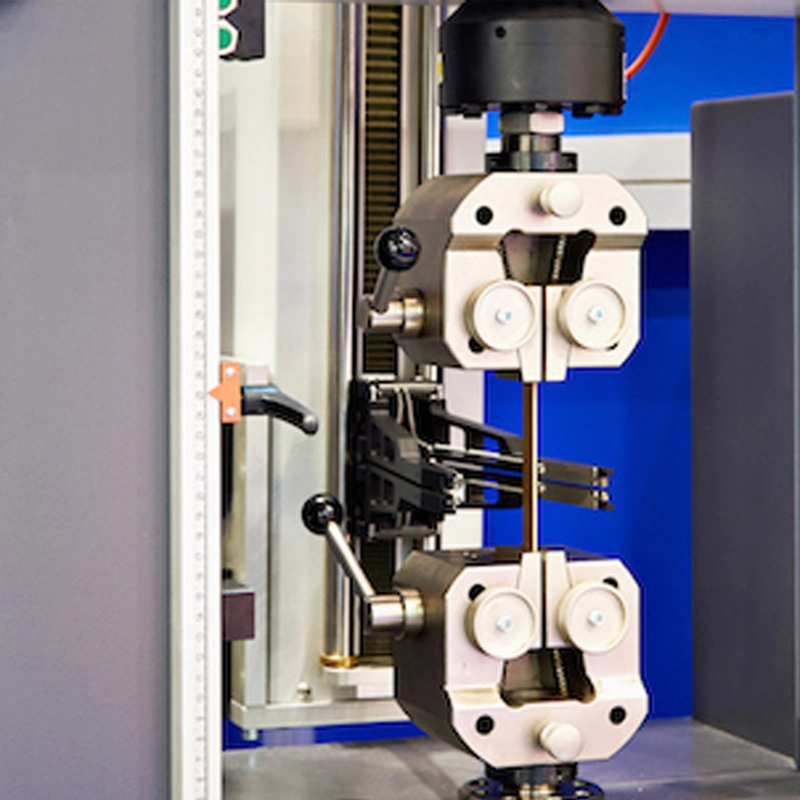
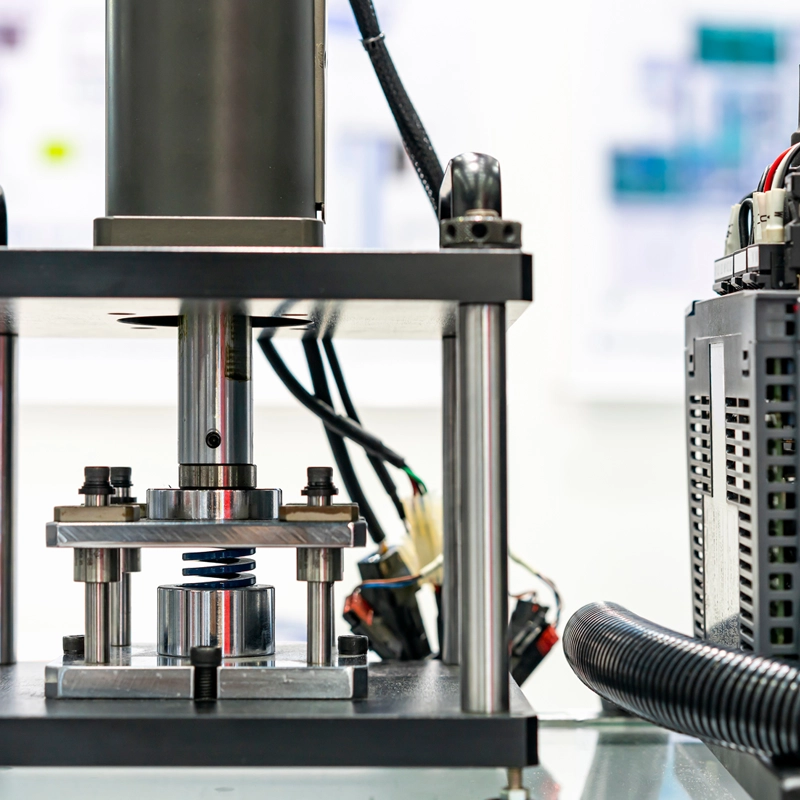
- Main components: actuator (servo-hydraulic or electrodynamic), grips/fixtures, load cell, extensometer/strain gages, and specimen temperature control.
- Environmental & control systems: humidity chambers, salt-fog rigs, thermal cycling ovens for TMF, and fluid immersion for corrosion fatigue.
- Data acquisition & safety: high-speed logging, automatic shutdown on fracture, and interlocks for operator safety.
Data from Fatigue Tests & Failure Analysis
Test outputs include S–N/ε–N curves, crack growth rates, fracture surfaces, and life scatter. Fatigue failure analysis examines stages: initiation (surface), short crack propagation, long crack propagation, and final unstable fracture. Fractography (SEM) reveals river patterns, beach marks, and origin points — critical for root-cause.
Standards & Industrial Applications
Adhere to ASTM and ISO standards (e.g., ASTM E466, E606, ISO 12107) for test procedures and reporting. Fatigue data underpin designs across aerospace, automotive, medical devices, energy, marine, electronics, and consumer products.
Advantages & Limitations
Advantages: reveals real failure modes, enables life prediction, improves safety, informs DFM and material choice, and lowers lifecycle costs.
Limitations: can be time-consuming and costly; reproducing field conditions exactly is difficult; results require statistical interpretation and should be combined with other tests.
Related Manufacturing Processes That Affect Fatigue Life
- Heat treatment (quenching/tempering) tailors microstructure and toughness.
- Surface finishing: shot peening induces compressive residual stress; laser peening and burnishing also improve life.
- Machining & grinding: proper procedures reduce harmful tensile residuals and surface microcracks.
- Coatings & platings: DLC, nitrides, and conversion coatings protect against corrosion fatigue.
- Additive manufacturing: AM introduces unique porosity/anisotropy; post-processing (hot isostatic pressing, machining) is often required.
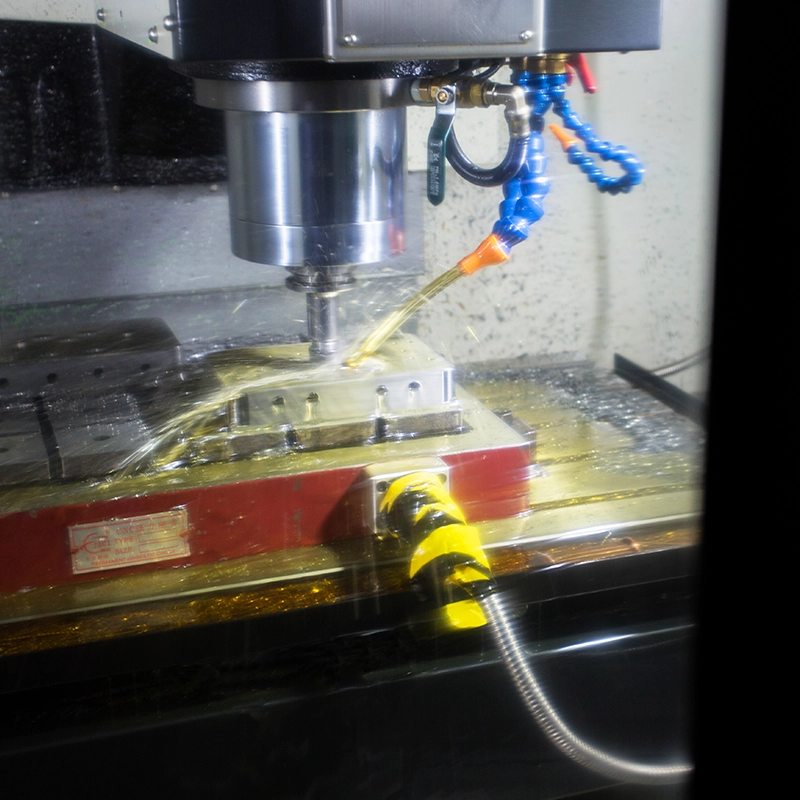
- Injection molding / LSR molding: process parameters influence orientation, voids, and local stresses in polymer parts; annealing and controlled cooling improve fatigue resistance in plastics and elastomers.
At LSRmold, our engineers advise on DFM (Design for Fatigue), process controls, and supplier selection so that fatigue performance is designed into parts, not tested in later.
Conclusion
Fatigue testing bridges material science, structural mechanics, and manufacturing. Selecting the right material, processing route, and test method — then analyzing data with robust statistical and fracture-mechanics tools — is essential to predictable product life. Partnering with an experienced manufacturer and test provider who integrates DFM, process know-how, and one-stop OEM service reduces risk and shortens development cycles.
If you need fatigue testing, life-prediction modeling, or DFM review for a component, LSRmold offers high-quality testing coordination, materials expertise, and production services. Contact our technical team to discuss your test plan, arrange sample testing, or request a fatigue-driven DFM analysis. We’ll help you turn test data into safer, longer-lasting products.